
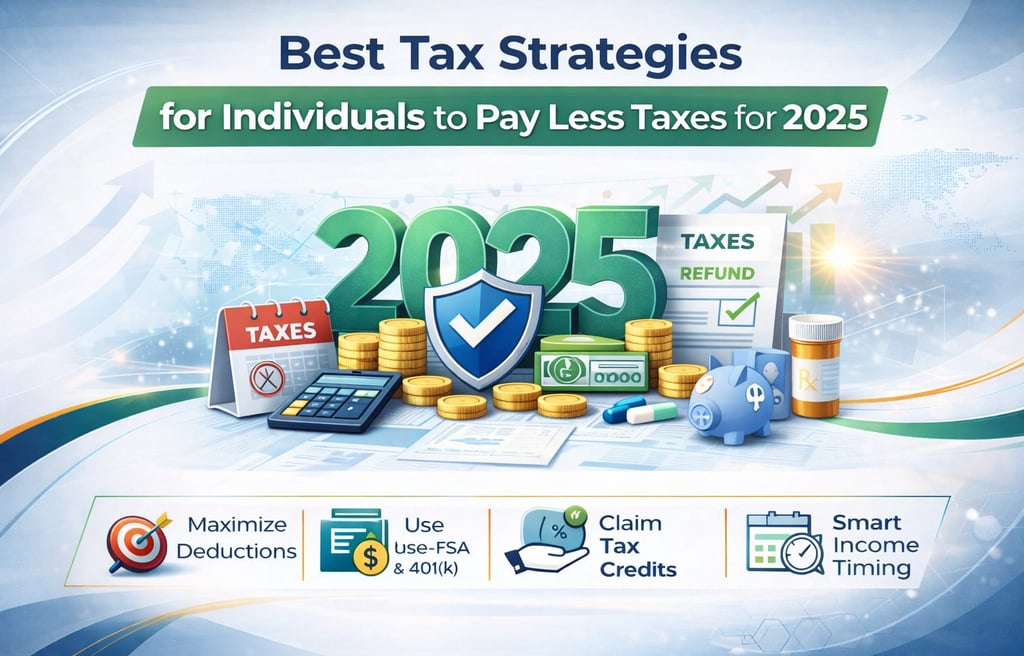
Best Tax Strategy for Individuals to Pay Less Taxes in 2025?
1/4/20265 min read
Here’s a comprehensive and practical tax-planning strategy for individual taxpayers in the United States preparing for the 2025 tax year (filed in 2026). The most effective tax strategies are not complex loopholes — they involve understanding how income, deductions, credits, and timing decisions work together to legally reduce your tax liability.
Smart tax planning should ideally begin before the end of the tax year, not during filing season. The strategies below focus on lowering taxable income, maximizing available credits, and positioning your finances for long-term tax efficiency. Always consult a qualified tax professional for personalized guidance.
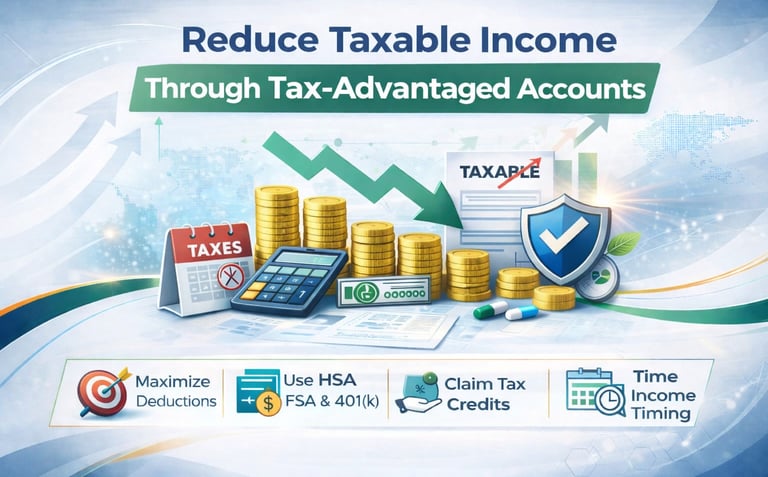
1. Reduce Taxable Income Through Tax-Advantaged Accounts
One of the most reliable ways to pay less in taxes is to reduce the amount of income the IRS can tax in the first place. Tax-advantaged accounts allow individuals to shelter income legally while building long-term financial security.
Retirement Accounts
401(k), 403(b), and similar employer-sponsored plans allow employees to contribute pre-tax income directly from payroll. Contributions reduce your taxable wages for the year, meaning you pay taxes on a smaller income amount today while saving for retirement.
For 2025, contribution limits are expected to be approximately $23,500, with additional catch-up contributions available for individuals age 50 and older. Many employers also offer matching contributions, which effectively provide additional compensation.
Traditional IRA Contributions
A Traditional IRA may provide a tax deduction depending on income level and employer retirement plan participation. Deductible contributions lower adjusted gross income (AGI), which can also help qualify taxpayers for additional credits or deductions.
Estimated contribution limit: $7,000, with higher limits for those age 50+.
Health Savings Account (HSA)
An HSA remains one of the most powerful tax tools available because it provides a triple tax advantage:
✔ Contributions reduce taxable income
✔ Investment growth accumulates tax-free
✔ Withdrawals for qualified medical expenses are tax-free
Unlike FSAs, unused HSA funds roll over indefinitely and can even function as a supplemental retirement account after age 65.
Flexible Spending Accounts (FSAs)
Healthcare and dependent-care FSAs reduce taxable wages through payroll deductions. These accounts are particularly useful for predictable medical expenses, childcare costs, or elder care expenses.
Because FSAs typically follow a “use-it-or-lose-it” rule, careful planning is important when determining contribution amounts.
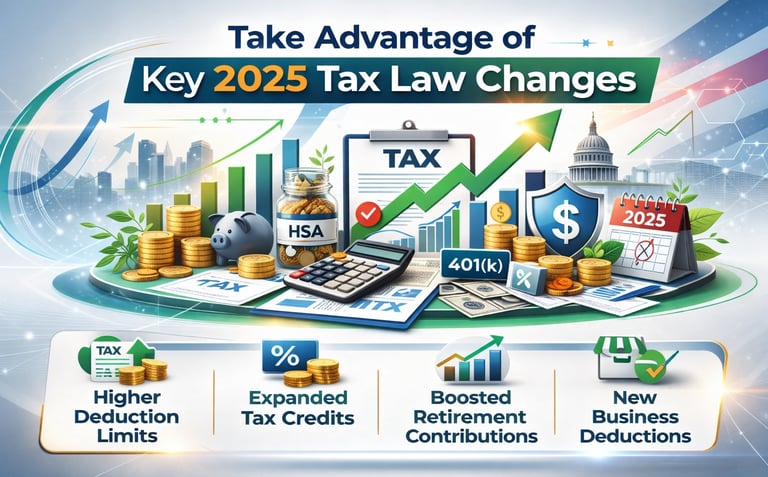
2. Take Advantage of Key 2025 Tax Law Changes
Tax laws evolve frequently, and understanding annual updates can significantly change whether taxpayers benefit more from the standard deduction or itemizing.
Expanded SALT Deduction
For 2025, the State and Local Tax (SALT) deduction cap is expected to increase to as much as $40,000 for eligible taxpayers. This represents a substantial increase from the previous $10,000 limitation and may especially benefit homeowners in higher-tax states.
With this expansion, more taxpayers may find itemizing deductions financially advantageous again.
Senior Deduction
Taxpayers aged 65 or older may qualify for an additional federal deduction of roughly $6,000 per eligible individual, subject to income phaseouts. This additional deduction can meaningfully reduce taxable income for retirees or near-retirees.
Because of these changes, reviewing deduction strategy annually is critical rather than automatically claiming the standard deduction.
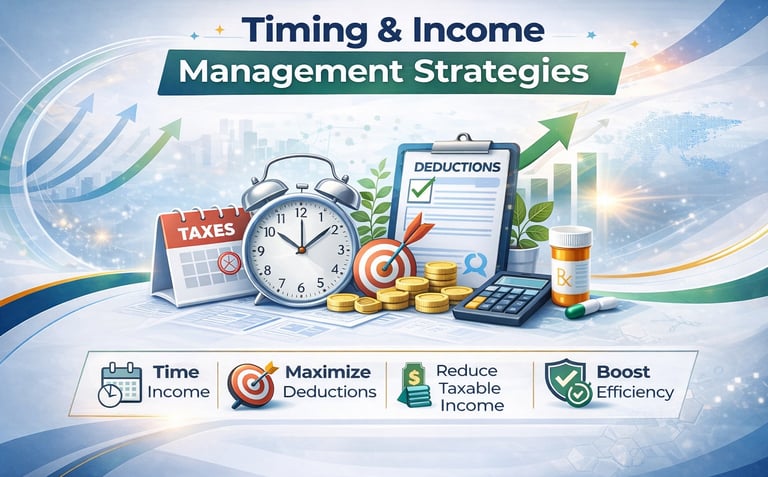
3. Timing & Income Management
Strategic timing of income and expenses can shift taxation into more favorable years and reduce overall lifetime tax liability.
Income Deferral Strategies
When possible, taxpayers may delay receiving income until the following tax year. Examples include:
Deferring year-end bonuses
Delaying freelance invoices
Postponing investment sales
This approach is particularly effective if you expect to fall into a lower tax bracket next year.
Capital Gains Planning
Investment taxation can often be optimized through careful planning.
Tax-loss harvesting allows investors to sell underperforming investments to offset capital gains realized elsewhere in their portfolio. Excess losses may even offset ordinary income within IRS limits.
Additionally, holding investments for more than one year qualifies gains for lower long-term capital gains tax rates rather than higher short-term rates taxed as ordinary income.
Roth IRA Conversions
A Roth conversion involves transferring funds from a traditional retirement account into a Roth IRA. Taxes are paid at the time of conversion, but future qualified withdrawals become tax-free.
This strategy works best during:
Lower-income years
Early retirement years before Social Security begins
Market downturns when account values are temporarily lower
4. Deductions & Credits You Shouldn’t Miss
Many taxpayers overpay simply because they overlook deductions or credits they legitimately qualify for.
Itemized Deductions
Common itemized deductions include:
Mortgage interest payments
Property taxes
Charitable donations
A useful strategy called “bunching” deductions involves concentrating multiple years of charitable contributions into one tax year to exceed the standard deduction threshold and maximize savings.
Energy & Home Improvement Credits
Federal energy incentives continue to reward homeowners who invest in energy-efficient upgrades such as:
Solar panels
Energy-efficient windows or insulation
Heat pumps and efficient HVAC systems
Credits directly reduce taxes owed dollar-for-dollar, making them especially valuable compared to deductions.
Education Savings — 529 Plans
Contributions to 529 education savings plans grow tax-deferred, and withdrawals for qualified education expenses are federally tax-free. Many states also provide additional state tax deductions or credits for contributions.
These plans can be used for college expenses and, in some cases, K-12 tuition or student loan repayment limits.
5. Other Strategies to Consider
Beyond deductions and retirement planning, several smaller strategies can collectively create meaningful tax savings.
Employer Stock Purchase Plans (ESPPs)
Participating in an ESPP allows employees to purchase company stock at a discount. Holding shares long enough to meet favorable tax treatment rules may reduce taxes owed on gains.
W-4 Withholding Review
Reviewing your Form W-4 annually ensures proper tax withholding. Over-withholding results in smaller paychecks throughout the year, effectively giving the IRS an interest-free loan, while under-withholding may lead to penalties.
Using the IRS withholding estimator can help align withholding with actual tax liability.
State Tax Planning
State income taxes significantly impact total tax burden. Long-term planning may include relocation, remote work considerations, or residency optimization in lower-tax states where appropriate.
⚠️ Important Points
This information provides general tax education and should not replace personalized professional advice.
Tax rules vary based on income level, filing status, and state residency.
Tax laws can change through new legislation or IRS guidance.
Avoid aggressive or questionable tax schemes that may trigger audits or penalties.
For advanced planning involving estates, trusts, investments, or business income, working with a CPA or tax attorney is highly recommended.

Social Connection
© 2026. All rights reserved.