
Fix Your Bookkeeping to Fix Your Money
1/4/20265 min read


The Structural Advantage Behind Profitable Businesses
Bookkeeping is not simply about “tracking numbers.” It is the system that converts daily business activity into structured financial control. Every payment received, every expense incurred, and every obligation created becomes part of a documented financial framework that supports decision-making. Without this framework, business owners operate reactively—responding to cash shortages, unexpected expenses, and unclear margins after the fact. With professional bookkeeping, financial data is organized to highlight trends, identify pressure points, and strengthen stability.
When financial records are incomplete or inconsistent, performance becomes difficult to measure. Revenue may appear strong, yet hidden costs, delayed receivables, or unrecorded liabilities can quietly weaken the business. Structured bookkeeping eliminates that uncertainty by showing not only where money has gone, but where it is committed, where it is expected, and how it supports ongoing operations.
The difference between a struggling business and a stable one often comes down to financial visibility. Businesses that maintain disciplined records operate with foresight. Businesses that neglect bookkeeping operate with delayed awareness—and delayed awareness is expensive
1. Liquidity Control: Preventing Cash Crunches Before They Happen
Many businesses fail not because they lack profitability, but because they run out of cash at critical moments. Profitability measures long-term sustainability; liquidity determines short-term survival. Professional bookkeeping separates profit from available cash by clearly distinguishing:
Accounts receivable (money owed to you)
Accounts payable (money you owe)
Accrued expenses
Deferred revenue
These distinctions create a complete picture of cash timing. Without this structure, business owners may assume revenue equals spendable cash—only to discover upcoming obligations that reduce actual cash available.
Accurate bookkeeping allows owners to monitor working capital, the difference between current assets and current liabilities. When working capital declines, it signals potential strain before a crisis develops. This visibility enables businesses to plan vendor payments, manage payroll with confidence, and avoid relying on high-interest emergency financing.
Liquidity control is not just about avoiding problems. It strengthens vendor relationships, protects credit standing, and ensures the business can operate without constant financial pressure.
2. Margin Protection Through Expense Classification
Profit margins rarely collapse overnight. They erode gradually when expenses are not classified with precision. Detailed bookkeeping assigns costs to specific categories—cost of goods sold, operating expenses, fixed overhead, and variable costs—allowing businesses to measure profitability accurately.
Without this structure, expenses appear as a single total, masking where margin leakage occurs. Different costs require different management responses:
Rising material costs directly affect gross margin and may require price adjustments or supplier negotiation.
Increases in subscription or administrative expenses affect the operating margin and may indicate inefficiency.
Higher payroll increases fixed-cost exposure and requires alignment on productivity.
When expenses are properly classified, management can respond strategically rather than reactively. Instead of cutting costs unthinkingly, decisions are targeted and informed.
Margin protection begins with visibility. Bookkeeping provides that visibility.
3. Pricing Accuracy and Break-Even Analysis
Pricing decisions determine whether a business grows sustainably or operates under hidden strain. Accurate bookkeeping provides the cost structure necessary to calculate break-even points and sustainable pricing thresholds.
When fixed and variable costs are documented correctly, a business can determine:
The exact revenue required to cover operating expenses.
The unit sales needed to maintain profitability.
The margin required to support growth and reinvestment.
Without reliable financial data, businesses risk underpricing their services to compete. Increased sales volume does not guarantee increased stability if margins are miscalculated.
Professional bookkeeping ensures pricing decisions are supported by real cost data, protecting long-term financial health
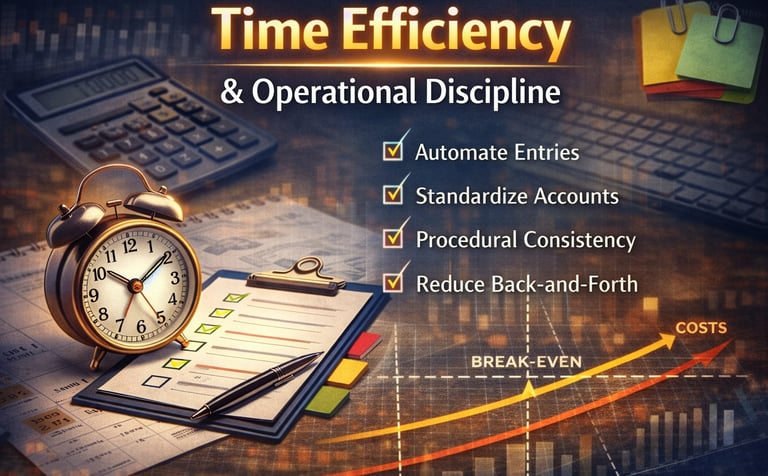
4. Time Efficiency and Operational Discipline
Disorganized financial records create operational friction. Time spent searching for receipts, correcting ledger errors, or reconstructing transaction histories is time taken away from serving clients and generating revenue.
A structured bookkeeping system reduces this friction by:
Automating recurring entries
Standardizing account categories
Establishing consistent month-end procedures
Minimizing back-and-forth with accountants
With organized records, financial reporting becomes predictable and efficient. Management gains faster access to accurate reports, reducing stress during tax season, financing reviews, or audits.
Operational discipline in bookkeeping supports smoother internal coordination and lowers the administrative burden on leadership.
5. Debt Management and Creditworthiness
When seeking financing, lenders evaluate documented financial performance—not assumptions. They rely on structured financial statements to assess repayment capacity and operational reliability.
Consistent bookkeeping produces reliable:
Income statements
Balance sheets
Cash flow statements
Businesses with organized books demonstrate financial responsibility and stability. This reduces perceived risk and improves negotiating power when applying for loans or credit lines.
Strong bookkeeping can influence approval speed, borrowing capacity, and even interest rates. Financial clarity improves financial opportunity.
6. Audit Readiness and Risk Containment
Financial discrepancies are easier to correct when records are up to date and reconciled regularly. Routine reconciliation ensures that internal records align with bank accounts and financial institution records.
This process helps detect:
Duplicate payments
Clerical errors
Unauthorized transactions
Missing entries
Early detection limits financial exposure and prevents small errors from becoming significant losses. Organized documentation also reduces disruption during audits or compliance reviews, minimizing professional fees and operational interruption.
Prepared businesses operate with confidence, not anxiety.
7. Tax Optimization Through Documentation Integrity
Tax compliance depends on documentation. Bookkeeping preserves the records necessary to support deductions, allocations, and financial disclosures.
This includes documentation for:
Depreciation schedules
Mileage logs
Business-use allocations
Equipment purchases
Home office deductions
Without organized records, legitimate deductions may be missed or difficult to substantiate. Accurate bookkeeping ensures businesses claim what they are entitled to while reducing audit risk.
Tax season becomes a structured process rather than a stressful reconstruction exercise.
8. Strategic Timing and Capital Allocation
Financial records reveal patterns in revenue cycles, expense trends, and cash flow timing. This insight enables businesses to make more informed timing decisions.
Bookkeeping enables management to:
Schedule capital investments during periods of strong liquidity.
Delay discretionary spending during slower revenue cycles.
Adjust staffing or expansion plans based on predictable financial patterns.
Growth decisions made with financial timing awareness reduce strain and improve sustainability. Expansion becomes calculated rather than reactive.
9. Psychological and Leadership Impact
Financial ambiguity creates hesitation. When leaders lack reliable data, decisions are delayed or based on assumptions. Clear, organized records eliminate uncertainty and increase confidence.
With accurate bookkeeping, business owners can:
Make hiring decisions with clarity.
Invest in growth with measurable risk.
Adjust pricing with confidence.
Leadership grounded in documented financial facts is more decisive and more strategic. Confidence supported by data strengthens every aspect of the business.
Fix Bookkeeping
Bookkeeping is not an administrative expense—it is a structural advantage.
It protects liquidity, preserves margins, supports pricing decisions, improves access to credit, and reduces compliance risk.
Fix your bookkeeping, and you restore control over your cash, your margins, and your growth trajectory

















Social Connection
© 2026. All rights reserved.